

Window to Chiang Mai Thailand
Window to Chiang Mai Thailand
Elephant Care & Trekking Tours
Half to one Day. Return 52 km. Lamphun station is 2 km from the old town. Regular buses begin at Chang Phuak bus station and may be caught at the start of the old Chiang Mai - Lamphun Road near the Nawarat Bridge.)
Lamphun remains a small provincial town on H106. The quieter pace of Lamphun makes it an attractive destination for those interested in historical culture. The old city is in the shape of an oval surrounded by lotus-filled moats and by the Kuang River on the east side.
History of Lamphun
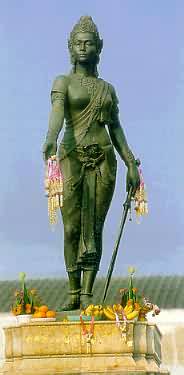 Lamphun (formerly Haripunchai) is amongst the oldest cities in Thailand and predates Chiang Mai by several centuries. Northern Thai chronicles suggest the city of Haripunchai was founded by some Buddhist monks in 661 AD, but the actual date may have been as late as the mid-ninth century.
The chronicles tell how some Buddhist monks wished to establish a city and invited Queen Chamadevi from Lopburi to be the first ruler (a statue of the queen stands in a small park near the south-west corner of the old city moats). The city survived Lawa attacks and eventually assimilated the Lawa and other ethnic groups.
Lamphun was part of the Mon Dvaravati civilization which developed along trade routes from the Gulf of Martaban to the Chao Phraya River basin and beyond to the north and east.
Queen Chamadevi's dynasty lasted till the mid- 11th century, when Lamphun may have been temporarily evacuated due to a cholera epidemic. However it remained as the center of the valley until it was captured by Mangrai in 1281. Mangrai used Lamphun as his capital for four years before seeking a better place. From the foundation of Chiang Mai in 1296, Lamphun has been dominated by its northern neighbor.
Lamphun City Sights
Wat Chamadevi
See location at Google Maps: Wat Chamadevi
(Wat Kukut. 1 km. west on R1015 to Sanpatong. Trishaw - 20 THB.) Two chedi that are the sole intact remains of the Dvaravati civilization in Thailand stand in the grounds of this temple.
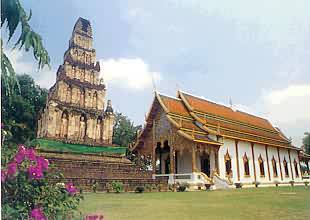 The larger of the two chedi is a square stepped pyramid made of laterite. Known as the Mahapol Chedi (or the Suwan Chang Kot Chedi), the original chedi dates back at least to the 10th century.
It has since been enlarged and renovated. The four sides at each level contain three standing Buddha images in niches. The frames around the niches are highly decorated with stucco. The chedi at Wat Chedi Liam in Wiang Kum Kam is a copy of this design.
A second smaller octagonal chedi of similar age is known as the Ratana Chedi. It has eight standing Buddha images in the first section above its base. The adjacent modern viharn contains a mural that depicts King Viranga of the Lawa throwing a javelin towards the city.
Wat Phrathat Haripunchai
See location at Google Maps: Wat Phrathat Haripunchai
(Inthayongyot Road, east side)
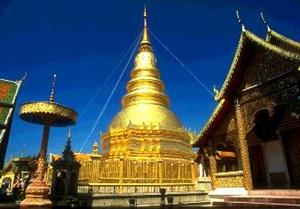 This temple is one of the most famous temples in Northern Thailand. Large lions guard the main entrance gate that faces the Kuang River to the east. A reclining Buddha image fills a small building nearby.
The temple grounds form a square with a 46 meters high chedi at it's center. The chedi is said to be built on the site of Queen Chamadevi's palace.
Construction on the chedi probably began in the late ninth century, but it was enlarged at the beginning of the 12th century. The chedi took its final shape in the rein of King Tilokarat in the 15th century.
The parasols at the corners and on the pinnacle of the chedi were placed by Kawila. The nine-tiered umbrella at the top of the chedi is in the Sri Lankan style, which reflects the origins of Theravada Buddhism in the region. On the full moon day of the sixth lunar month, an annual homage and bathing ceremony of the Phrathat is held.
 The main viharn, a large structure containing the Phra Chao Thongtip Buddha and several smaller images was rebuilt in 1925. South of the viharn is a small 19th century scripture repository . Moving west along the south wall of the sanctuary one finds a small sala with four Buddha footprints within each other.
In the south-west corner a small museum has a fine silver Buddha image in the Haripunchai-style as well as several good examples of 15-16th century Lanna Buddha images.
Next to the museum on the south side is the Than Chai viharn. The viharn contains a standing Buddha image as well as some remarkable murals that were painted in the 1950's. The west and north walls depict Buddhist bells and the east and south walls scenes from the coming of the next (Maitreya) Buddha.
In the north-west corner, the small Suwanan Chedi was built in 1467 as a replica of the original at Wat Chamadevi.
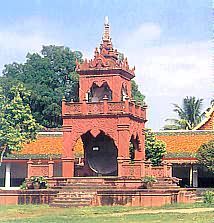
Finally, the compound contains a red Shan-looking structure holding a bell and a large gong.
Wat Phra Yuen
See location at Google Maps: Wat Phra Yuen
(1 km. east across narrow bridge over the Kuang River in front of Wat Phrathat Haripunchai.)
Located in a grove, the temple has a chedi with a large square base and four tall standing Buddha images in arched niches. The old site is said to go back to the 11th century when a large standing Buddha image was built in the grove.
The temple was expanded when Phra Sumana Thera stayed for two years around 1370. His visit is recorded on the oldest stela in the Chiang Mai valley, which still stands under a small shelter near the entrance to the temple. An English explanation of the writing is provided at the site.
Old residents have recorded that the original structure at the site of the present chedi was a mondop with a pinnacled wooden roof (the mondop in the ubosot of Wat Phra Singh is thought to be a loose copy of this vanished structure).
The structure had four standing Buddha images twice the height of the present ones. The chedi was rebuilt in a Burmese-style at the beginning of last century.
Haripunchai National Museum
(Inthayongyot Road opposite Wat Phrathat Haripunchai. Open Wednesday to Sunday 08:30-16:00 10 THB.)
The museum contains a good display that includes some excellent examples of Haripunchai art.
Ku Chang
See location at Google Maps: Ku Chang
(1.5 km -follow the narrow road north-east along the banks of the Kuang for a kilometer; a lane to the north called Thanon Ku Chang leads to the site.)
Local people have left many carved wooden elephants in front of the first of two chedis at Ku Chang. Queen Chamadevi's legendary elephant is said to be buried here.
See also:
The Three Javelins Hong Dipterocarpus Alatus The Lohasimbali Hell
Sightseeing Guide
South to Lamphun

