

Window to Chiang Mai Thailand
Window to Chiang Mai Thailand
Elephant Care & Trekking Tours
When Visiting a Temple
Thais prefer visitors to temples to cover their bodies as a sign of respect for their religion. Religious objects like Buddha images and chedi should not be climbed upon or touched. When Thais sit on floors, they do not point their feet in a direction worthy of respect, such as a Buddha image, monk, or a teacher. They consider the head as "high" and the feet as "low".
Chiang Mai Temples are the cultural and historical heart of the city. The most famous have been places of pilgrimage for northern people for centuries. As traditional centers of merit making, they are the best places to see Buddhist ceremonies. Funded by noble and wealthy benefactors over a long period, they have also become the repositories of some of the finest examples of religious art. If you had but half a day in the city, then it is to one or two of these temples that you should go.
The Lanna Temple
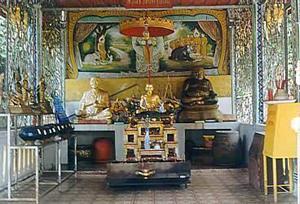 Thai temples have long served as the center of the community. While this traditional role has diminished as young people have had less time for religious observances, the temples still lie at the heart of the ritual and social life of much of society.
Though earlier temples were the most durable constructions of the day, the wooden roofs and older earth filled walls have not survived the destructive forces of nature and man. Therefore most of the temple buildings seen today do not go back much before the 19th century.
Only the stupas (which shall be referred to as chedi) and some walls and sculptured images which were built of laterite or brick covered with stucco have survived for longer periods.
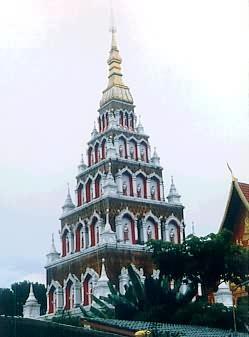 Lanna Temples originally were built round the chedi (stupas), which contain valuable relics of pious kings and monks. Like solid rocks in a sea of change, the old chedis mark the sites of former temples and are almost the only temple structures that go back to the 13th-15th centuries.
Perhaps their continued existence in some unlikely places in Chiang Mai is no accident. In Brahmanic-Buddhist cosmology, the chedi "stabilizes the earth", fixing a point where heaven and earth meet. They may be likened to the rising sun at dawn, both separating and joining the earth and sky after the darkness of night. Symbolizing the dhamma, they chase away the darkness of ignorance and chaos.
Though many chedi in Chiang Mai have been damaged by thieves who sought the precious relics contained inside, citizens have repaired and protected them. They are worshipped as sacred symbols representing the cosmic body of the Buddha and the law of the dhamma. Their shape differs, however, due to the particular symbolism of the dhamma chosen by the builders.
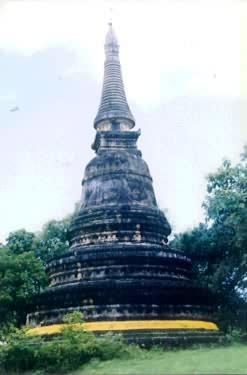
Chedis in Chiang Mai have two basic forms; the stepped or prasat style, and the bell style. However, from these basic forms many variations in size and shape have appeared, reflecting the wealth of Chiang Mai over the centuries.
 An early example of the prasat style is the Mahapol Chedi at Wat Chamadevi in Lamphun. Later fine examples are those of Wat Pansat near Chang Phuak bus station and Wat Lok Moli west of Chang Phuak gate.
The chedi of Wat U-Mong Suan Putha-tham and the later chedi of Wat Phrathat Haripunchai have the bell shaped style. More recent examples are the Shan Burmese style chedis built in the late 19th century. These may be seen at the temples on Thapae Road. Other variations include the octagonal form, which may best be seen at Wat Phrathat Doi Suthep and Wat Duang Di, and the round form best seen at Wat Phuak Hong. Both designs may have evolved here, or may have come with monks or traders from Ayutthaya (the octagonal form) and Lake Erhai in Yunnan (the round form).
Lanna Temple Buildings
The Ubosot and Viharn are the most ornate and important buildings in a temple compound. On the outside they are decorated with stucco motifs which are covered with lacquer, glass mosaic and gilt.
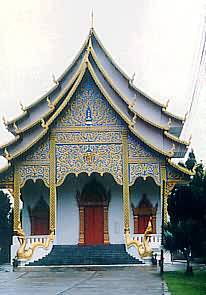 An Ubosot, or consecrated ceremonial hall, is generally small for its religious functions involve only monks. The ubosot stands in consecrated ground marked by eight boundary stones. Ubosot are often locked and women are generally not allowed to enter.
The viharn is a larger assembly hall where lay people and monks participate in ceremonies. It is usually located to the east of the chedi with the front entrance facing east, the auspicious direction of the sunrise.
Though many viharn in the north are characteristically Lanna in style, details in the architectural styles have been influenced by Ayutthaya and Rattanakosin (Bangkok) styles. Taller walls in the viharn, for example, show a distinct influence of the central (Siamese) Thai. Both the ubosot and the viharn will contain the temple's most important Buddha images. During ceremonies cotton strings may be attached to these to spread the power and blessings of the image amongst devotees. Because of the value of these images and other artifacts, many viharn are kept locked except on Buddhist holy days - wan phra (monks may unlock a viharn if politely requested to do so).
The viharn is often decorated with elaborate murals, which are usually bright and of recent origin. Scenes from the Jataka, the previous lives of the Buddha, may adorn the side walls.
The wall above the front entrance traditionally shows the unsuccessful attack by the demon of Mara, the God of Illusion who attempts to dissuade the Buddha from achieving enlightenment.
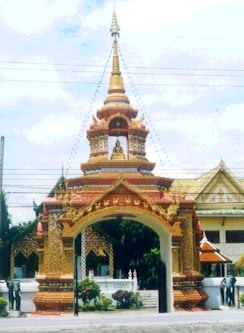 Many temples contain a small scripture repository raised up on a pedestal or stilts for protection. Known as ho trai, they are used to keep religious scripts inscribed on palm leaves. These scripts recorded Buddhist texts as well as the chronicles, which are a main source of early Thai history. One of the best examples of a ho trai is at Wat Phra Singh.
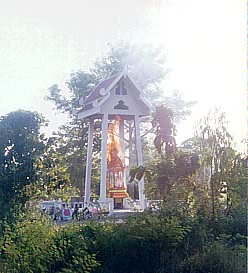
Other buildings include kuti, the monks' living quarters, general purpose halls known as sala, and a bell tower which announces ritual times to monks.
Temples used to provide the only education and to this day compounds often contain schools. From ancient times the temple grounds have served as a public place for festivals and fairs. The entrances to compounds of important temples in the past would sometimes have heavily decorated entrance gates. Wat Suan Dok is the best example in Chiang Mai.
Funeral rites are held in special halls, or at the home of the deceased. Cremations are carried out at special grounds away from the temples.
See also:
The Emerald and Jade Buddhas
Sightseeing Guide
The Main Temples

