

Window to Chiang Mai Thailand
Window to Chiang Mai Thailand
Elephant Care & Trekking Tours
Seventy percent of the land in the north is mountainous and in the past was densely forested, making overland communication difficult. As a result each valley developed slight variations in customs and language.
People practiced wet-rice subsistence agriculture and were self-sustaining, making what they needed. Customs and beliefs associated with the agricultural cycle were passed down from their ancestors.
The People
The people of the valleys refer to themselves as the khon muang, and are of mixed origin. The first inhabitants were known as the Lawa. These people were joined by other groups moving along the trading routes of the river valleys.
Notable amongst these were the Mon, who originated from the region around Thaton in Myanmar. The Mon founded Haripunchai, a northern offshoot of the Dvaravati civilization that predominated in the Chao Phraya basin from the 6th - 10th centuries. By the 13th century, however, the dominant group were ethnic Tai, who had been migrating south into the valleys from at least the 10th century (some theories plausibly suggest the Tai may have been in the area long before this date). This group came to be known as the Tai Yuan.
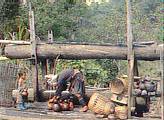 Until the European colonialism of the 19th century, the politics of the north was dominated by the struggles with the Burmese, and between the kingdoms of Ayutthaya, Lanna and Lan Xang. Each military incursion involved forced relocation of populations to increase manpower. Thus the wars of the region served mainly to mix ethnic Tai groups. Such resettlements tended to be geographically based, resulting in subtle differences within the population of the valley to this day.
The second half of the 19th century saw a large influx of overseas Chinese coming up from the South, as well as Haw Chinese coming overland from Yunnan. Many of the latter were Muslims who had fled to the hills after the brutal Chinese suppression of the Panthay rebellion in Yunnan in 1873. At the same time the hilltribes were also moving south through the uplands.
In the mid 19th century Westerners started arriving with Christian missionaries and increased in numbers with the growth of the teak industry. The teak industry also attracted large numbers of Shan who worked all over the north for the logging companies.
The 20th century has seen large migrations of hilltribes as well as Kuomintang Chinese, who fled China after the communist victory of 1949. Finally the recent economic growth has attracted people from all over Thailand. The incorporation of Lanna into the global market place brought to an end the relative cultural isolation of the once remote northern valleys.
Language
The main ethnic language of the north is kham muang. With differences in both vocabulary and tones, Northern Thai may be considered a different language from central Thai. Though the differences are diminishing as kham muang borrows from the state language, a person from central Thailand cannot immediately understand the northern language.
Words of Indian origin trace their roots to Pali through the Mon civilization, as opposed to those of central Thai which came from Sanskrit via the Khmer civilization of Angkor. Kham muang has its own script used in religious texts, but most local people are unable to read it.
Religion
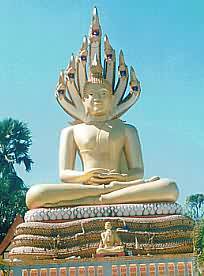 Although Mahayana Buddhism may have come to the region first via the Khmer empire and the Silk Road from China, Theravada Buddhism had become the dominant form of Buddhism by the end of the 14th century.
Theravada Buddhism in its essence is about the dhamma, the truth according to the Buddhist view. As the state religion of Lanna, however, it became connected with Brahmanic court traditions. These came from the indianised empires of the Khmer at Angkor and the Myanmarns at Pagan, which were at the height of their power in the 12th and 13th centuries.
Prior to the dominance of these beliefs, the Tai were animists with a fertility cult centered on the wet-rice cultivation cycle. The blend of the Tai spirit world with Buddhism has resulted in the variety of customs and religious practice today. See Spirits and Mediums
Central to the traditional Thai view of the cosmos is the cycle of rebirth. To commit sin is to be reborn into a hell world, and to make merit is to progress into a better after-life. A forest monk may explain this to a Westerner as an allegory for the laws of cause and effect known as karma. To a Thai villager, near Mae Chaem the holy images in the temples are the home of powerful spirits, and the vivid depictions of heaven and hell are maps that help him find his way in the cycle of seasons and years.
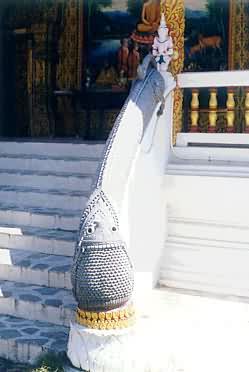 The temple has long been the social center of rural Thai communities and Buddhism is woven into the fabric of rural life. The monk-hood originally provided the only education available and served to occupy males without work, especially during the rainy season. To this day folk festivals involve making merit by supporting the monk-hood with food and labor.
Until quite recently the temple was the main outlet for artistic creativity, the greatest works coming as a result of sponsorship by the ruling nobility. By so doing the rulers not only gained merit, but also gained political legitimacy, as pious works were seen as a crucial part of a leader's majesty.
Buddhist values pervade the character of the Thai, who value maintaining harmony in relationships very highly. To avoid causing offense, Thais pay much attention to outward appearance. However, they also prize having a "cool heart" - being jai yen. This means that you should not allow yourself to become "hot" with desire and at the mercy of worldly passions which can lead to harmful actions.
Buddhism also teaches tolerance, and so people have been free to practice other religions. Islam first arrived with Muslim Yunnanese who have been trading in the northern valleys since the time of the Mongols (11th - 13th centuries). The first permanent Christian mission was established in 1867. McCormick Hospital is one of several major institutions that came about with the growth of Christianity in the valley.

