

Window to Chiang Mai Thailand
Window to Chiang Mai Thailand
Elephant Care & Trekking Tours
Introduction to Lanna
Chiang Mai owes her existence to the Ping River. The river provided the route along which the power of Chiang Mai could be extended beyond the wall of mountains that surrounded the valley; it was a channel for trade from China See "Trade Links with China" and Myanmar to the Gulf of Siam. The wide, fertile valley was able to support a large number of people, the basis of political power in the feudal kingdom of Lanna (the million fields).
The Ping River Valley was long a trading route between Yunnan and the Chao Phraya basin.
Evidence from archeological remains has shown that early inhabitants used iron tools in the valley at least two thousand years ago. These early people, who came to be known as the Lawa, were later supplanted by the Mon of the Dvaravati period (6- 10th centuries). Drawn by trade along the river, the Mon chose the wide, fertile valley to found Haripunchai (Lamphun), in the eighth century. It was the first city-state with a "high culture" in the valley.
The rich valley also attracted King Mangrai, a powerful Tai leader, who captured Haripunchai and then founded his "new capital" - Chiang Mai - in 1296. 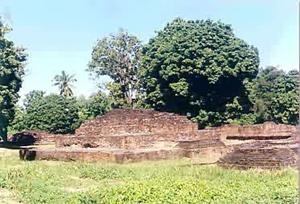
He chose a site typical for a Tai city - at the foot of a mountain that provided both water and timber.
Chiang Mai was the capital of the kingdom of Lanna (the kingdom of a million fields), which enjoyed a golden age throughout the 15th century. During this age the powerful inland kingdom came to control most of what now constitutes northern Thailand, north-western Laos, the eastern Shan states of Myanmar and Xishuangbanna in southern Yunnan. The religion of the kingdom -Theravada Buddhism - gave rise to a cultural wealth whose influence was to be felt beyond the kingdom's boundaries down the centuries.
However, Lanna was caught between the Burmese, united under King Bayinnaung of Pegu, and the Siamese Thai of Ayutthaya. Lanna fought several times against Ayutthaya in the 14th and 15th centuries, draining the strength of the kingdom. Weakened by internal struggles for the throne and by oppression, the city fell to the Burmese forces of King Bayinnaung in 1558.
For over two centuries (1558-1774) Chiang Mai was under Burmese control. The fortunes of Chiang Mai declined for the Burmese exploited the city-state for military purposes in their wars with Ayutthaya. Rebellion brought suppression.
Eventually northern Thai forces allied with the Siamese drove the Burmese out, but Chiang Mai was so weak that it was totally abandoned.
With Siamese help, Chao Kawila of Lampang repopulated Chiang Mai with local people and with Tai Yai (Shan), Tai Khoen from Kengtung, and Tai Yong from Muang Yong east of Kengtung; he formally re-established Chiang Mai in 1796. To this day many of the people of Chiang Mai and Lamphun find their ethnic origins in the Tai groups who came here under Kawila.
Allied to the Siamese Thai, Chiang Mai gained strength.
 During the 19th century increasing Western interests in the teak forests of the north, however, forced King Chulalongkorn (Rama V) of Siam to take over the administration in 1892. In the second half of the century, the first Westerners as well as large numbers of overseas Chinese established themselves in the valley.
Economic integration with Siam, (which came to be named Thailand in 1949) became firmer with the opening of the railway in 1921. However, the historical trade routes to the north - to Jinghong in Xishuangbanna prefecture of Yunnan and Kengtung in Myanmar - have been blocked by political barriers for much of the century.
Thus Chiang Mai remained a quiet city until tourism brought the development boom of the seventies and eighties.
The last twenty years has seen the development of the modern city and consumer work culture. The growth of the Bangkok metropolis to saturation has partly encouraged this. The present population of Chiang Mai province totals almost 1.5 million people, with well over 200,000 making their home in Chiang Mai area. Plans to reopen trade routes that link Chiang Mai to its original sphere of influence as the capital of Lanna provide a bright prospect for Chiang Mai 700 years after its foundation.
Important Dates in Lanna History
767
(or in the early ninth century) Haripunchai was founded by hermits who invited Princess Chamadevi of Lop Buri to rule.
1259
Mangrai (r. 1259-1317) became King of Ngoen Yang. He moved his capital to Chiang Rai (1262) and then to Fang (1268).
1281
King Mangrai captured Haripunchai. He moved his capital to Wiang Kum Kam around 1288.
1296
King Mangrai founded Chiang Mai.
1345
King Pha Yu (r.1337-1355) founded Wat Phra Singh and laid the foundation for the golden age of Lanna, which began with the reign of his son King Ku Na.
1371
King Ku Na (r.1355-1385) founded Wat Suan Dok for Phra Sumana Thera, establishing a Sinhalese Buddhist sect that became the major cultural influence in Lanna.
1385
King Saen Muang Ma (r. 1385-1401) fought off an attack from Ayutthaya, but was defeated when he attacked Sukhothai in 1387.
1405
King Sam Fang Kaen (r. 1401-1441) repelled Yunnanese armies and consolidated the Kingdom of Lanna.
1449
King Tilokarat (r.1441-1487) captured Nan, bringing Lanna to the height of its power. Considered the greatest of the Lanna kings after Mangrai, he brought Lanna to a "golden age", supporting Buddhist works and construction.
1477
The Eighth World Buddhist Council met at Wat Jet Yod to revise the Buddhist canon, bringing Lanna culture to its zenith.
1495
King Muang Kaew (r.1495-1526) patronized the arts as the last of the great kings of Lanna. His successor, King Chettarat (r.1526-38 & 1543-45), was deposed in favor of his son, was enthroned again and then was assassinated.
1545
An earthquake damaged the Phra Chedi Luang in a year that saw unsuccessful attacks on Chiang Mai by both a Shan prince and Ayutthaya.
1546
King Setthathirat of Luang Phrabang, the capital of the Kingdom of Lan Xang, ascended to the throne of Lanna (by invitation) only to return to his Lao capital upon the death of his father in 1547. Lanna collapsed into civil war between the chiefs of the principalities.
1551
Invited by local chiefs to rule, Phra Mekuti (r.1551- 1564) began an oppressive and unpopular rule. He forbade worship of Chiang Mai pillar, an act which is thought to have brought misfortune to Chiang Mai.
1558
Chiang Mai fell without struggle to the Burmese. Prince Mekuti, the last of Mangrai's descendants, remained in power as a vassal.
1564
Mekuti unsuccessfully tried to shake off Burmese rule and was deposed. Chiang Mai became a base for attacks on Ayutthaya, which fell to King Bayinnaung in 1569.
1598
King Naresuan (r.1590-1605) of Ayutthaya captured Chiang Mai. Chiang Mai fell to the Burmese in 1614.
1661
King Narai (r.1656-1688) of Ayutthaya captured and briefly held Chiang Mai.
1767
The Burmese destroyed Ayutthaya. King Taksin regrouped at Thon Buri, building up Siamese strength.
1774
Phraya Chaban of Chiang Mai and Chao Kawilaof Lampang sided with the Siamese against the Burmese, defeating them.
1776
Chiang Mai was abandoned.
1796
Chao Kawila (r.1781-1815) re-established Chiang Mai.
1868
King Chulalongkorn - Rama V (r.1868-1910) began reforms that set the foundation for the modern state.
1871
Chao Inthawichayanon (r.1871-1897) became the last semi-independent ruler of Chiang Mai.
1874
A Siamese high-commissioner began to take over the administration of Lanna.
1885
The telegraph reached Chiang Mai
1892
Siam incorporated Lanna into the administrative unit of "Monthon Phayap".
1893
France forced Siam to cede Laos, which included territory within the traditional domain of Lanna.
1902
The Shan rebellion was the last stirring of northern independence.
1921
The railway reached Chiang Mai. Education was made compulsory.
1932
Chiang Mai became a province of Siam.
1946
King Bhumiphol Adulyadej became King Rama IX of Siam (the name of Thailand being officially recognized in 1949).
Sightseeing Guide
History of Chiang Mai

